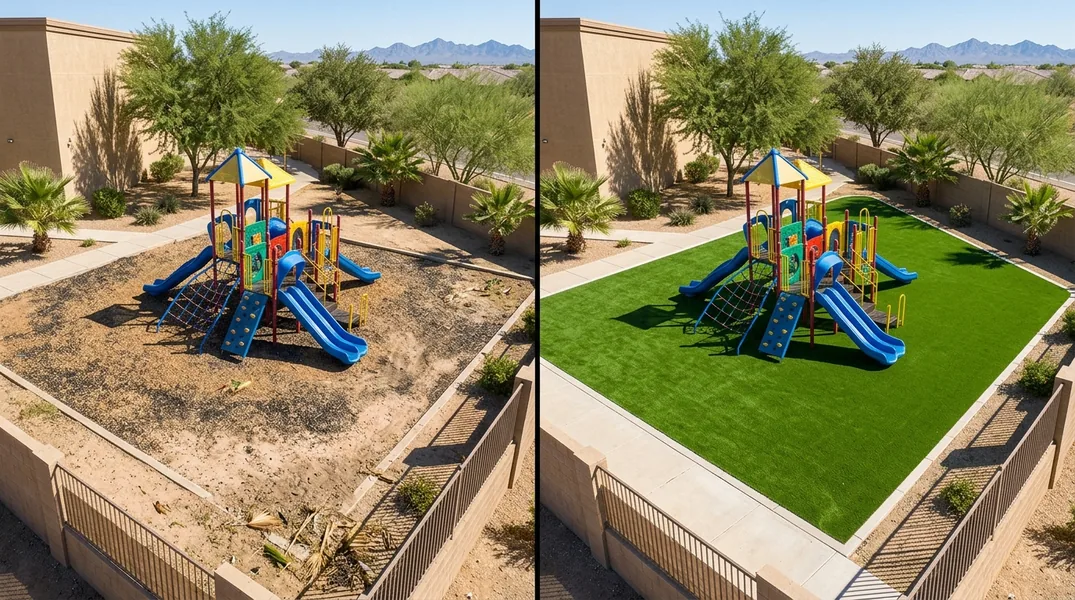
Why Base Preparation Matters on Caliche Soil
If you own property in Gilbert, you already know that caliche is a fact of life. This hard, calcium carbonate layer sits just beneath the topsoil across much of Arizona and creates a unique challenge for Residential Artificial Grass Installation. Caliche acts like a concrete barrier, preventing water from draining naturally into the soil below. When you install artificial turf without addressing this layer, water pools on top, creating mud, odors, and premature deterioration of your new lawn.
Proper base preparation is not optional in Gilbert. It is the foundation of a successful artificial grass installation that will last 15 to 20 years without becoming a swampy mess. The base layer determines how well water moves away from the turf surface, how level your lawn stays over time, and whether your investment remains attractive year after year. Skipping or rushing this step is the most common reason homeowners end up disappointed with their artificial turf.
Understanding Artificial Grass Drainage in Desert Soil
Artificial grass drainage works differently than you might expect. Unlike natural grass, which absorbs water through its root system, synthetic turf is impermeable. Water must flow through the turf fibers and backing, then down through the base layers, and finally away from the installation area. In Gilbert, where caliche blocks downward drainage, water has nowhere to go without a properly engineered solution.
The key to effective artificial grass drainage is creating a path of least resistance. This means removing or breaking up the caliche layer, installing appropriate drainage materials, and ensuring water can flow laterally away from the turf. On flood-irrigated horse lots, this becomes even more critical because you are dealing with periodic large volumes of water at once. A well-designed drainage system prevents water from sitting under the turf, which protects both the artificial grass and the underlying soil structure.
What to Put Under Artificial Grass: The Complete Layer System
Knowing what to put under artificial grass is essential for long-term performance. The proper base system consists of multiple layers, each serving a specific purpose. Starting from the bottom, you need a drainage layer that moves water away from the turf. On caliche soil, this often means breaking up or removing the hard layer entirely and replacing it with material that allows water to flow. Many professionals use a combination of crushed stone, gravel, or specialized drainage rock to create this foundation.
Above the drainage layer comes the compacted base layer, typically 2 to 4 inches of crushed limestone or similar material that compacts firmly and provides a stable, level surface. This layer must be properly graded to slope slightly away from structures and toward drainage points. Then comes the artificial grass underlay, a geotextile fabric that separates the turf from the base, prevents soil migration, and provides additional drainage. Finally, the artificial grass itself sits on top. Each layer has a job, and skipping or reducing any of them compromises the entire system.
Artificial Grass Underlay: Selecting the Right Material
The artificial grass underlay is often misunderstood by homeowners. It is not just a thin plastic sheet. Quality underlay is a engineered geotextile fabric designed to allow water to pass through while preventing sand and soil from migrating up into the turf backing. In Gilbert, where dust and fine soil particles are abundant, the right underlay prevents your artificial grass from becoming discolored and maintains proper drainage performance over years of use.
When selecting an underlay, look for products with documented drainage rates and UV resistance. The underlay should be at least 6 to 8 ounces per square yard to provide durability and proper water permeability. For horse lots and high-traffic areas, consider heavier-duty options. The underlay also provides a slight cushioning effect, which is beneficial for Pet Turf & Dog Run Installation and any area where comfort matters. Poor quality underlay will degrade quickly under Arizona sun and foot traffic, leading to drainage failure and turf deterioration.
Turf Base Prep for Flood-Irrigated Horse Lots
Flood-irrigated horse lots present a distinct challenge that goes beyond typical residential installations. When you flood irrigate, you are delivering large volumes of water across the entire lot at once. This water must drain quickly and completely, or your artificial turf becomes waterlogged and your horse lot becomes unusable. The turf base prep for this application requires extra attention to slope, drainage pathways, and base material selection.
For flood-irrigated lots, the base should be deeper and more robust than standard installations. Many professionals recommend 4 to 6 inches of compacted crushed stone, sloped at 1 to 2 percent toward drainage areas. The caliche layer must be thoroughly broken up or removed to ensure water can percolate downward. French drains or perimeter drainage systems may be necessary to capture and redirect water away from the turf area. Additionally, the base must be extremely level and well-compacted to prevent settling, which would create low spots that pool water. Proper turf base prep on a horse lot is an investment that pays dividends in functionality and longevity.
Working with Caliche: Breaking and Removal Strategies
Dealing with caliche requires specific techniques. You cannot simply install artificial grass over caliche and expect good results. The hard layer must be addressed, and Gilbert Turf Installation uses proven methods to handle this. Breaking up caliche involves heavy equipment and expertise. Shallow removal (breaking the layer to 6 to 12 inches deep) is often sufficient to allow water to percolate through. In some cases, complete removal of the caliche layer may be necessary, particularly on horse lots or areas with heavy water use.
The choice between breaking and removal depends on the depth of the caliche, the water table, and the specific use of the property. A professional assessment is the best way to determine the right approach for your situation. After caliche is addressed, the area is graded, compacted, and prepared to receive the base materials. This process takes time and equipment, but it is the only way to ensure your artificial grass installation will perform properly in Gilbert's unique soil conditions. If you are uncertain about caliche on your property, contact Gilbert Turf Installation at (602) 713-6323 for a professional evaluation.
Getting Professional Help: Residential Artificial Grass Installation Near Me
Base preparation is not a DIY project for most homeowners. The equipment, expertise, and knowledge required to properly address caliche, install drainage systems, and prepare a level base are best left to professionals. When you search for Residential Artificial Grass Installation near you in Gilbert, prioritize companies with experience on caliche soil and flood-irrigated properties.
Gilbert Turf Installation has the equipment, experience, and local knowledge to handle the unique challenges of Gilbert properties. Whether you have a small residential yard or a large horse lot, proper base prep is the foundation of success. We recommend getting a free estimate from a qualified local installer who can assess your specific soil conditions and recommend the right approach. Call (602) 713-6323 today to discuss your project and learn how professional base preparation will ensure your artificial grass looks great and performs reliably for years to come.
Looking for a professional artificial grass installation company in Gilbert? Gilbert Turf Installation responds fast for all your artificial grass installation needs.
Get a Free Quote